
Last Updated on August 21, 2026 by Max
Introduction: One Molecule, Two Opposing Roles
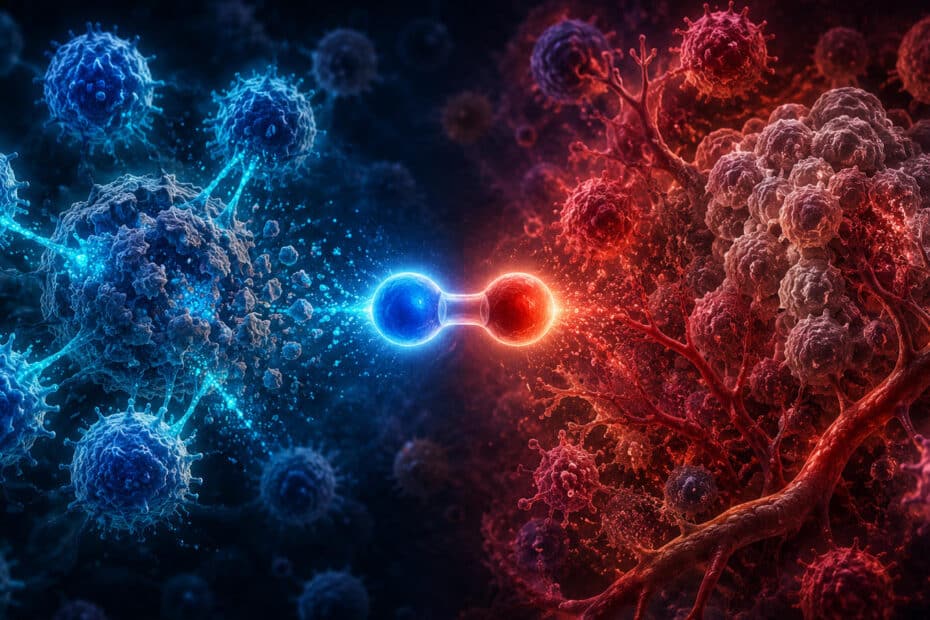
The same molecule that keeps your arteries open can help an immune cell destroy cancer—or help a tumor survive.
Nitric oxide (NO) is one of the body’s most versatile signaling molecules. Earlier articles in this series explored how NO relaxes blood vessels, improves glucose delivery, and drives normal erectile function. Cancer, however, changes the story. During a healthy immune response, immune cells first recognize abnormal cells. Activated macrophages can then release concentrated bursts of NO around their targets. This chemical attack disrupts energy production and damages essential proteins and DNA. Severe damage stops the abnormal cell from dividing or triggers apoptosis—its built-in self-destruct program.
- Introduction: One Molecule, Two Opposing Roles
- Nitric Oxide Is Not Simply Good or Bad
- How Nitric Oxide Helps the Immune System Destroy Abnormal Cells
- How Chronic Inflammation Turns NO Against You
- The NO Context Rule: Dose × Time × Place
- Nitric Oxide and Prostate Cancer: Why the Paradox Matters
- Do Beets and Leafy Greens Increase Cancer Risk?
- Can Doctors Target Nitric Oxide to Treat Cancer?
- How to Tilt the Balance in Your Favor—Without Chasing NO Levels
But NO does not always remain under tight control. Chronic inflammation can keep nitric oxide-producing enzymes active for months or years. NO then interacts with other reactive molecules, creating nitrosative stress. This process can damage healthy DNA and increase the chance of cancer-causing mutations. An established tumor can also use NO. Sustained signaling can help cancer cells adapt to low oxygen, attract new blood vessels, resist cell death, and escape immune attack (Thomas, D.D., 2017; Myśliwiec, A., 2025).
This paradox also applies to prostate cancer. Under some conditions, NO suppresses prostate-cancer growth. Under others, abnormal signaling supports tumor progression and resistance to hormonal treatment (Soni, Y., 2020). Therefore, the goal is not to maximize or eliminate nitric oxide. Instead, we need to protect healthy NO signaling while reducing chronic inflammation and metabolic dysfunction. In this article, you will learn how the immune system uses NO, how tumors hijack it, and how to support the protective side without falling for dangerous cancer claims.
Nitric Oxide Is Not Simply Good or Bad
Nitric oxide is often described as a protective molecule. Yet NO is also a reactive free radical, capable of damaging DNA and proteins. Both descriptions are correct. NO acts rapidly and usually travels only a short distance before reacting with nearby molecules. Therefore, its effects depend heavily on where and how it is produced.
Three Enzymes, Three Different Jobs
Your body produces NO through three forms of nitric oxide synthase:
- Endothelial nitric oxide synthase (eNOS or NOS3) produces brief, controlled signals inside blood vessels. This NO relaxes arteries, limits unnecessary clotting, and supports healthy circulation.
- Neuronal nitric oxide synthase (nNOS or NOS1) produces targeted signals in nerves. It helps regulate communication between nerve cells, muscle movement, and sexual arousal.
- Inducible nitric oxide synthase (iNOS or NOS2) becomes active during infection, injury, and inflammation. Immune cells use it to generate larger and more sustained amounts of NO against pathogens and abnormal cells.
The first two enzymes generally produce small, short-lived signals. In contrast, iNOS can remain active for hours or longer. This makes it a powerful immune weapon—but also a source of tissue damage when inflammation becomes chronic (Förstermann, U., 2012).
What Determines NO’s Effect?
The outcome depends on how much NO is produced, how long it remains present, where it appears, which cells release it, and what other reactive molecules surround it. A brief, concentrated burst beside an abnormal cell can support immune destruction. Persistent NO inside inflamed tissue can damage healthy DNA or activate signals that help a tumor survive. This is why nitric oxide cannot be classified as simply good or bad. Even the general rule that low NO promotes tumors while high NO kills them has exceptions. Tumor type, oxygen supply, immune activity, and genetic changes all influence the result (Thomas, D.D., 2017; Myśliwiec, A., 2025).
The goal is not to produce as much NO as possible. It is to maintain controlled production in the right place and at the right time. Next, we will examine how immune cells use nitric oxide to attack abnormal cells.
How Nitric Oxide Helps the Immune System Destroy Abnormal Cells
Macrophages are immune cells that engulf microbes, remove damaged tissue, and coordinate inflammation. When activated against a dangerous target, they increase iNOS expression. This enzyme converts L-arginine into large amounts of NO near the abnormal cell. Nitric oxide easily crosses cell membranes. Once inside its target, it interferes with mitochondrial respiration and energy production. It can also damage proteins and DNA. If this chemical stress becomes severe enough, the abnormal cell stops dividing or activates apoptosis—its controlled self-destruction program (Kashfi, K., 2021).
A five-step interactive explanation of how a macrophage uses a short, targeted nitric oxide burst against an abnormal cell, followed by a comparison between normal resolution and persistent inflammation.
The immune system identifies a dangerous target
Stress signals and abnormal surface markers alert nearby immune cells. The response remains local while the target is evaluated.
What happens after the strike?
Choose an outcome to compare controlled defense with persistent inflammatory signaling.
Nitric oxide also influences communication between immune cells. Under controlled conditions, it can make tumor cells more vulnerable to attack and more sensitive to cell-death signals. However, this protection depends on strict control. A localized, temporary response can support tumor destruction. Continuous NO production can injure healthy cells or weaken T-cell activity. This protective response shows nitric oxide at its best: targeted, powerful, and temporary. Problems begin when inflammation keeps the same chemistry active long after it is needed.
Nitric oxide affects vascular function, but endothelial health is only one part of healthy aging.
How Strong Is Your Healthspan Reserve?
Blood pressure, metabolic health, aerobic fitness, strength, mobility, sleep, nutrition, and other factors work together as we age. One strong area cannot always compensate for a hidden weakness.
See what is working well, what deserves more attention, and which evidence-based changes may have the greatest value for your healthy aging.
Explore Your Healthspan →How Chronic Inflammation Turns NO Against You
Acute inflammation is a short-term defense. Immune cells attack a threat, remove damaged tissue, and then reduce their activity. Chronic inflammation breaks this sequence. Immune signals remain active, and iNOS continues producing nitric oxide long after the original danger has passed.
In this environment, NO reacts with superoxide to form peroxynitrite and other reactive nitrogen species. These compounds damage proteins, disrupt DNA repair, and create mutations in nearby cells. At the same time, inflamed tissue keeps producing new cells to replace those being injured. This combination of DNA damage and continued cell division creates conditions that can support cancer development (National Cancer Institute, 2022).
Once a tumor forms, it can use sustained NO signaling for its own benefit. Rather than overwhelming cancer cells, lower and moderate NO levels can activate survival pathways. These signals help tumor cells resist death, adapt to low oxygen, and continue dividing. NO can stabilize HIF-1α, a protein that helps cells survive oxygen deprivation. It can also increase VEGF, which stimulates the growth of new blood vessels. This process, called angiogenesis, supplies the tumor with oxygen and nutrients. Other NO-dependent signals can support invasion, metastasis, and resistance to treatment (Somasundaram, V., 2019; Myśliwiec, A., 2025). Persistent NO production can also weaken T-cell activity and make the tumor environment less accessible to immune attack. What began as an immune weapon then becomes part of the tumor’s defense system.
The problem is not nitric oxide alone. It is uncontrolled NO production inside chronically inflamed tissue. Duration, concentration, and location determine whether the same molecule attacks a tumor or helps it survive.
The NO Context Rule: Dose × Time × Place
Nitric oxide’s effect can be understood through a simple rule: consider its dose, duration, and location together. No single factor predicts the outcome.
Interactive biology explorer
Nitric Oxide Double-Edge Explorer
Select a biological setting to see how dose, time, and place change nitric oxide’s effect.
Targeted antitumor defense
A temporary, concentrated response can overwhelm an abnormal cell while limiting wider tissue exposure.
Conceptual explainer only—not a personal cancer-risk score, NO test, or treatment calculator.
Activated macrophage produces concentrated nitric oxide beside an abnormal cell, creating mitochondrial and DNA stress that can stop growth or trigger apoptosis.
A concentrated immune attack can damage a tumor because NO reaches the target quickly and locally. Lower NO levels can become harmful when they persist inside chronically inflamed tissue. Instead of killing cells, they act as signals that help damaged or malignant cells survive. These patterns are guides, not exact thresholds. Each tumor has its own oxygen supply, genetic changes, immune activity, and ability to repair damage. Researchers have not identified one blood or tissue NO level that is universally protective against cancer (Thomas, D.D., 2017; Myśliwiec, A., 2025). Food and supplements also cannot reproduce the precise NO concentrations used by immune cells or experimental cancer treatments. The key is biological control—not simply more or less nitric oxide.
Nitric Oxide and Prostate Cancer: Why the Paradox Matters
The prostate often develops low-grade inflammation with age. Inside this environment, immune cells, blood vessels, and prostate cells can all produce nitric oxide. Studies of human prostate tumors have linked strong iNOS expression with more aggressive disease and poorer survival. However, iNOS has not performed better than established prognostic factors, such as tumor stage and grade (Aaltomaa, S.H., 2001).
NO and the Androgen Receptor
Most prostate cancers depend on the androgen receptor (AR) for growth. Laboratory studies show that NO can modify this receptor through a process called S-nitrosylation. This change prevents the receptor from binding normally to DNA and reduces the activity of androgen-controlled genes. Under these experimental conditions, NO slowed both androgen-dependent and castration-resistant prostate tumors (Qin, Y., 2013).
Yet another side of the paradox exists. Sustained signaling through the eNOS–NO pathway can support prostate cancer stem-like cells and increase resistance to antiandrogen treatment. These surviving cells can continue growing despite therapies designed to block androgen signaling (Gao, W., 2022). These findings are not truly contradictory. They reflect different NO concentrations, cellular sources, exposure times, and stages of cancer. A strong, targeted NO exposure can suppress prostate-cancer cells. Persistent signaling inside the tumor can help selected cells adapt and survive.
What This Means Clinically
Most evidence comes from cells, animal models, and observational tissue studies. Doctors do not use NO or iNOS measurements to diagnose prostate cancer or select treatment. No clinical evidence shows that NO-boosting foods or supplements prevent or treat the disease. For now, nitric oxide remains an important biological clue—not a treatment that patients can safely manipulate themselves. Its paradox reinforces the central lesson of this article: in prostate cancer, context matters more than simply having more or less NO.
Do Beets and Leafy Greens Increase Cancer Risk?
The short answer is no. Current evidence does not support avoiding beets, spinach, arugula, or other nitrate-rich vegetables to prevent cancer. The confusion comes from similar chemical names. Vegetables contain nitrate, while processed meats often contain added nitrate or nitrite. However, these compounds do not act in isolation. The surrounding food determines which chemical reactions occur.
The Food Matrix Changes the Outcome
Vegetables provide nitrate together with vitamin C, polyphenols, fiber, and other protective compounds. Vitamin C and polyphenols limit the formation of potentially carcinogenic N-nitroso compounds in the stomach.
Processed meats create a different environment. Nitrite can react with proteins and heme iron during processing, cooking, or digestion. These reactions can produce N-nitroso compounds, some of which damage DNA. Smoking, high-temperature cooking, and added salt introduce further risks. For this reason, the International Agency for Research on Cancer classifies ingested nitrate or nitrite as “probably carcinogenic” only under conditions that promote internal nitrosation. It does not classify nitrate-rich vegetables themselves as carcinogenic (IARC, 2010).
Choose a nitrate source to compare its food matrix, chemical context and the meaning of current evidence. This tool does not calculate personal cancer risk.
Choose a nitrate source
Bottom line: A nitrate-rich vegetable is chemically different from nitrite-cured meat.
Recent studies also show why the source matters. Nitrate and nitrite from vegetables have not been associated with higher overall cancer risk. Less favorable associations appear with food additives, processed meat, and some drinking-water exposures (Chazelas, E., 2022; Erichsen, D.W., 2024). The practical message is simple: continue eating nitrate-rich vegetables as part of a balanced diet, but limit processed meat. Whole vegetables support normal NO production without reproducing the chemical environment found in cured meats.
This evidence does not prove that concentrated nitrate or “NO-boosting” supplements prevent cancer. Food-based nutrition and high-dose supplementation remain very different strategies.
Can Doctors Target Nitric Oxide to Treat Cancer?
Blocking Tumor-Supporting NO
Nitric oxide’s double role has inspired two opposite treatment strategies. Researchers are testing ways to block the NO that helps tumors survive and ways to deliver a destructive dose directly into cancer cells. Some tumors maintain high activity of iNOS or other nitric oxide synthases. This persistent signaling can promote inflammation, angiogenesis, immune suppression, and treatment resistance. NOS inhibitors aim to interrupt these processes. Early clinical studies have tested the NOS inhibitor L-NMMA with chemotherapy in aggressive breast cancers. A phase II trial is also evaluating an iNOS inhibitor with alpelisib and nab-paclitaxel (ClinicalTrials.gov, NCT05660083). These studies remain experimental and apply to specific tumor types.
Blocking NO is challenging because healthy blood vessels and organs also depend on it. A drug that suppresses NOS throughout the body can constrict arteries, raise blood pressure, and disrupt normal immune function. Researchers therefore need selective inhibitors that act mainly inside the tumor.
Delivering a Destructive NO Dose
The opposite strategy attempts to flood cancer cells with a high, localized dose of NO. Experimental NO-releasing drugs and nanoparticles can damage tumor DNA, disrupt mitochondrial energy production, and increase sensitivity to chemotherapy or radiation. The main challenge is delivery. NO released throughout the body can lower blood pressure and harm healthy tissue. New systems aim to release it only inside tumors, using low oxygen, acidity, enzymes, heat, or light as triggers (Myśliwiec, A., 2025).
Neither NOS inhibitors nor tumor-targeted NO donors represent standard cancer treatment today. The research is promising, but success depends on controlling the dose and location with far greater precision than any food or supplement provides. Patients should not try to reproduce these strategies with beetroot, arginine, citrulline, or commercial NO boosters. Experimental tumor targeting and general NO supplementation are fundamentally different.
How to Tilt the Balance in Your Favor—Without Chasing NO Levels
“Tilting the balance” does not mean raising or suppressing nitric oxide throughout your body. No food, supplement, or home test can control NO precisely inside a tumor. The practical goal is to reduce chronic inflammation while protecting normal vascular, metabolic, and immune function.
Focus on Proven Cancer Prevention
- Avoiding tobacco is one of the most powerful steps. Tobacco smoke increases oxidative stress, damages DNA, and disrupts normal NO signaling.
- Maintaining a healthy weight and controlling blood sugar also matter. Obesity and insulin resistance promote persistent inflammation and create conditions that support several cancers. Regular exercise improves metabolic health and normal endothelial NO production. Current guidelines recommend 150–300 minutes of moderate activity or 75–150 minutes of vigorous activity each week.
- A plant-rich eating pattern provides vegetables, fruit, legumes, whole grains, nuts, and protective phytochemicals. Nitrate-rich vegetables can remain part of this pattern. Limit processed meat, heavily processed foods, and alcohol (American Cancer Society, 2025; World Cancer Research Fund, 2025).
- Good sleep and treatment of persistent infections or inflammatory conditions also support healthy immune regulation. However, evidence that these actions directly change NO inside a human tumor remains limited.
What Not to Do
Do not use beetroot, L-arginine, L-citrulline, or commercial NO boosters as cancer treatments. No clinical evidence shows that these products prevent or destroy tumors. Supplements also cannot reproduce the targeted NO doses used in laboratory research. Anyone receiving cancer treatment should discuss supplements with the oncology team. Patients should not stop prescribed nitrate medicines, blood-pressure drugs, or other treatments to manipulate NO. These actions reduce cancer risk through many connected pathways—not nitric oxide alone. Healthy habits support normal NO regulation, but screening and evidence-based medical care remain essential.
- Aaltoma, S.H., Lipponen, P.K., & Kosma, V.M. (2001). Inducible nitric oxide synthase (iNOS) expression and its prognostic value in prostate cancer. Anticancer Research, 21(4B), 3101–3106. PubMed
- American Cancer Society. (2025). American Cancer Society Guideline for Diet and Physical Activity for Cancer Prevention. American Cancer Society
- Chazelas, E., Pierre, F., Druesne-Pecollo, N., et al. (2022). Nitrites and nitrates from food additives and natural sources and cancer risk: Results from the NutriNet-Santé cohort. International Journal of Epidemiology, 51(4), 1106–1119. https://doi.org/10.1093/ije/dyac046
- ClinicalTrials.gov. (2026). Alpelisib/iNOS inhibitor/nab-paclitaxel in patients with HER2-negative metaplastic breast cancer (NCT05660083). ClinicalTrials.gov
- Erichsen, D.W., Pokharel, P., Kyrø, C., et al. (2024). Source-specific nitrate and nitrite intakes and associations with sociodemographic factors in the Danish Diet, Cancer and Health cohort. Frontiers in Nutrition, 11, 1326991. https://doi.org/10.3389/fnut.2024.1326991
- Förstermann, U., & Sessa, W.C. (2012). Nitric oxide synthases: Regulation and function. European Heart Journal, 33(7), 829–837. https://doi.org/10.1093/eurheartj/ehr304
- Gao, W., Wang, Y., Yu, S., et al. (2022). Endothelial nitric oxide synthase (eNOS)–NO signaling axis functions to promote the growth of prostate cancer stem-like cells. Stem Cell Research & Therapy, 13, 188. https://doi.org/10.1186/s13287-022-02864-6
- International Agency for Research on Cancer. (2010). Ingested nitrate and nitrite, and cyanobacterial peptide toxins. IARC Monographs on the Evaluation of Carcinogenic Risks to Humans, Volume 94. IARC report
- Kashfi, K., Kannikal, J., & Nath, N. (2021). Macrophage reprogramming and cancer therapeutics: Role of iNOS-derived NO. Cells, 10(11), 3194. https://doi.org/10.3390/cells10113194
- Myśliwiec, A., Bartusik-Aebisher, D., & Aebisher, D. (2025). The role of nitric oxide in cancer treatment: Ally or foe? Molecules, 30(13), 2802. https://doi.org/10.3390/molecules30132802
- National Cancer Institute. (2022). Targeting inflammation emerges as a strategy for treating cancer. National Cancer Institute
- Navasardyan, I., & Bonavida, B. (2021). Regulation of T cells in cancer by nitric oxide. Cells, 10(10), 2655. https://doi.org/10.3390/cells10102655
- Qin, Y., Dey, A., Purayil, H.T., & Daaka, Y. (2013). Maintenance of androgen receptor inactivation by S-nitrosylation. Cancer Research, 73(22), 6690–6699. https://doi.org/10.1158/0008-5472.CAN-13-1042
- Somasundaram, V., Basudhar, D., Bharadwaj, G., et al. (2019). Molecular mechanisms of nitric oxide in cancer progression, signal transduction, and metabolism. Antioxidants & Redox Signaling, 30(8), 1124–1143. https://doi.org/10.1089/ars.2018.7527
- Soni, Y., Softness, K., Arora, H., & Ramasamy, R. (2020). The Yin Yang role of nitric oxide in prostate cancer. American Journal of Men’s Health, 14(1), 1557988320903191. https://doi.org/10.1177/1557988320903191
- Thomas, D.D., & Wink, D.A. (2017). NOS2 as an emergent player in progression of cancer. Antioxidants & Redox Signaling, 26(17), 963–965. https://doi.org/10.1089/ars.2016.6835
- World Cancer Research Fund/American Institute for Cancer Research. (2018). Diet, Nutrition, Physical Activity and Cancer: A Global Perspective—Third Expert Report. Official report information

How Healthy Are Your Arteries? Take This 2-Minute Self-Check

Cancer and Reproductive Health: The Surprising Benefits of Cordyceps in Focus
Potassium Bromate: The Unseen Ingredient in Your Bread
Foods Reducing the Risk of Prostate Cancer: Tomatoes

Brewing Up Prostate Health: The Green Tea Guide Every Man Needs