
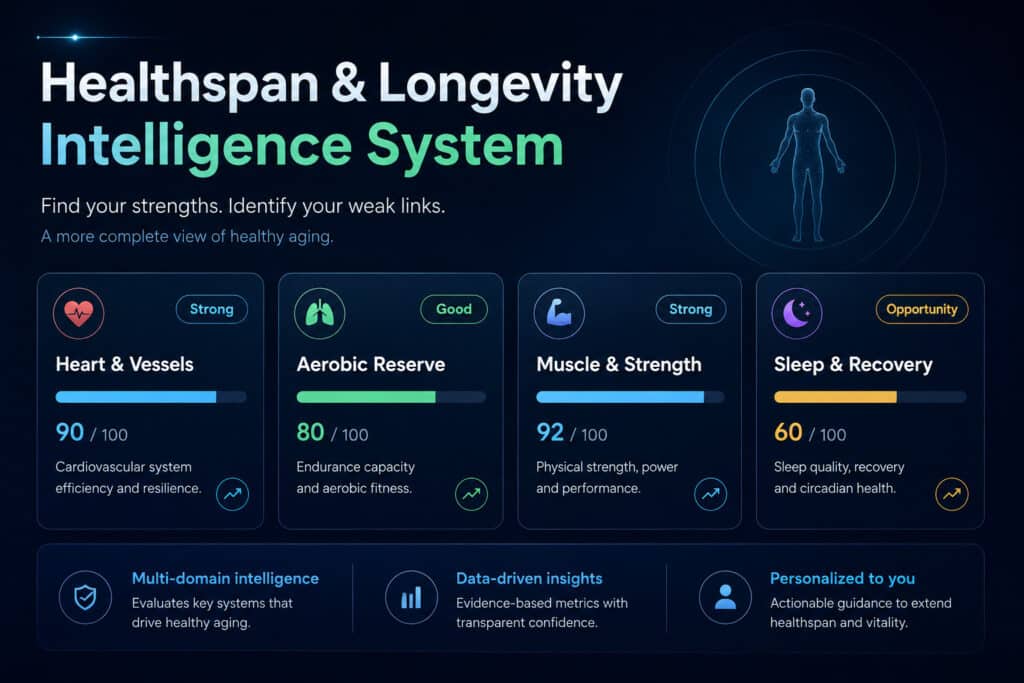
A quick look inside
See how the
System works.
From the information you enter to the next step you choose. Take a short tour of your profile, practical plans, and ways to explore change.
Start with what you already know.Free to explore · No registration · Add information at your own pace
Explore the SystemRead the video transcript
Your health is more than a single number. See the bigger picture with the Healthspan and Longevity Intelligence System.
Start with information you already know. Add existing lab results or fitness measurements when you have them.
Explore thirteen areas, from heart health and strength to sleep, memory, and social connection. Missing information stays visible.
Each area shows what deserves attention: maintain, improve, verify information, or arrange clinical follow-up. Open any result to understand why.
Recommendations connect your results to a practical Action Plan. Choose one focus, work through clear stages, and save your observations for review.
Curious about a change? What If lets you explore a hypothetical scenario while keeping your actual Results and plan unchanged.
In Trends, compare saved measurements and results. Dates and context help distinguish new measurements from edits. These example records are test data.
Learn explains the ideas behind your results, so you can explore questions at your own pace.
This free educational tool supports understanding, not diagnosis. Try it, and tell us: was your next step clear?
Discover Your Healthspan Weak Links
Healthy aging depends on more than cholesterol, weight, fitness, or one “biological age.” The System looks separately at disease risk, physical reserve, and intrinsic capacity so an important weakness cannot disappear inside an overall score.
3–5 minutes to start · No registration · Use only what you know · Data stays in your browser
Start My Quick Assessment ↓See an example of the results:
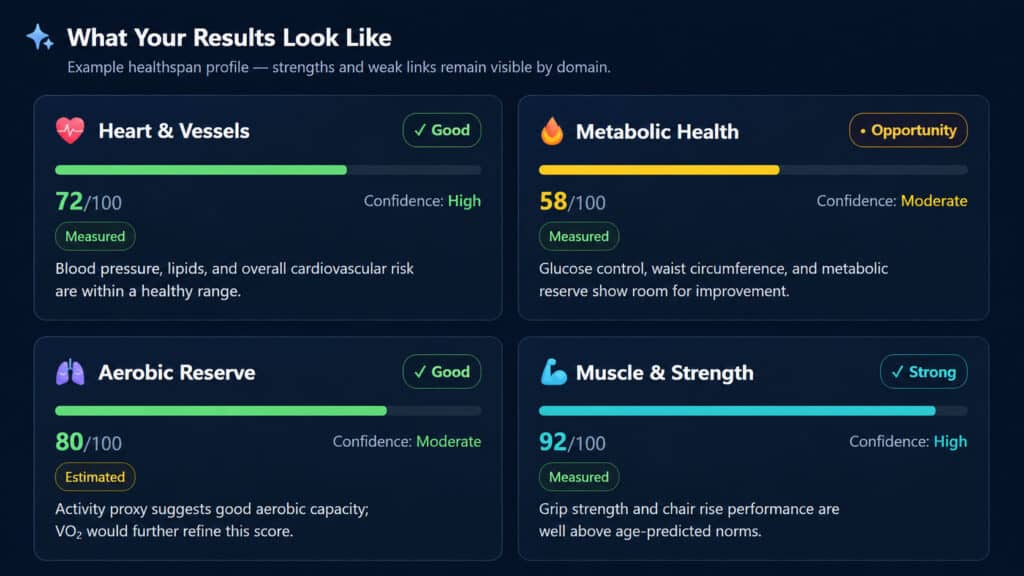
How to Read Your Results
Your overview brings all 13 health domains together. Each detailed result explains what your entries suggest and what kind of attention may be useful. Start with Current direction:
- Clinical follow-up: Read the specific safety or care message. The message explains the urgency.
- Verify: Check the named missing or uncertain information. This does not automatically mean you need a new test.
- Improve: Your entries identify a concern you may be able to address. Observation or review may come before choosing a habit.
- Maintain: Continue the favorable pattern or useful care supported by your entries. Keep any separate care advice in view.
Some domains also have a number out of 100 and a display band. The band summarizes the numerical result; the direction identifies the next kind of attention. A Good score can appear with Verify or Improve.
These are display categories, not diagnostic thresholds, percentages of health or personal treatment targets.
Bone & Fracture Resilience, Body Composition, Cognitive Capacity, Sensory Capacity, and Psychological & Social Resilience use contextual or categorical results. Missing scores remain gaps; they are not counted as zero.
There is no overall longevity score. A favorable result in one domain does not erase a concern in another.
These categories are not diagnoses. Clinical findings that may require medical attention are flagged separately.
Why You Can Trust the Approach
Evidence-Based
Built around current clinical guidelines, validated reference data, and established healthy-aging research.
More Than Biomarkers
Combines disease risk with fitness, strength, mobility, recovery, cognition, and other dimensions of healthy aging.
No Oversimplified Biological Age
Important weaknesses remain visible instead of disappearing inside one overall longevity score.
Privacy-Conscious
Your assessment information remains in your browser on your device in the current version.
Three Ways the System Looks at Healthy Aging
The System does not reduce health to one number. It looks at three complementary dimensions so important weaknesses remain visible.
Disease-Risk Control
Looks at established risk factors linked to long-term disease burden and future health outcomes.
- Blood pressure
- Cholesterol and lipids
- Blood sugar control
- Kidney and vascular risk
Physical Reserve
Evaluates how much functional capacity your body has available right now.
- Aerobic fitness
- Muscle strength
- Mobility and balance
- Bone and body resilience
Intrinsic Capacity
Focuses on the broader abilities that help you stay active, capable, and engaged in everyday life.
- Sleep and recovery
- Cognition and sensory health
- Psychological resilience
- Social and functional capacity
Don’t Just See Where You Are — Explore What Could Change
The What If…? simulator lets you explore how your profile could change if key factors improve.
This helps turn the assessment into something more practical: not just where you stand, but where your best opportunities may be.
Start the Assessment ↓Ready to explore your healthspan?
Start with what you know. You can improve the precision later. In just a few minutes, you can begin to see where your healthspan reserve appears strongest—and where your next effort may have the greatest value.
What Did You Think?
You’ve explored your healthspan profile. Now I’d really like to hear what worked for you — and what could be better.
Even one or two sentences are helpful. Your feedback directly influences future versions of the System.
Want to Understand the System in More Detail?
You don’t need to read these sections to use the assessment. Open any topic below when you want more detail.
How scoring works
The System evaluates health domains separately rather than combining everything into one overall longevity score. A serious weakness in one area therefore cannot be cancelled out by strengths somewhere else.
Direct measurements generally carry more weight than lifestyle proxies. For example, measured aerobic fitness provides stronger information than exercise frequency alone.
Missing information does not count against your health score. It lowers confidence in that part of the assessment until better information is available.
Results are shown as Strong, Good, Opportunity, Priority, or Major Priority. These categories are not diagnoses. Potentially important clinical findings are flagged separately.
How to improve accuracy
Begin with the Quick Assessment. Then add measurements you already have if you want a more complete profile.
Useful additions include LDL cholesterol, HbA1c, kidney measurements, blood pressure, body composition, and physical-performance tests.
Reference context is available for many laboratory fields. If you do not know a result, leave it blank rather than guessing.
As more direct measurements are added, the System can rely less on estimates and self-reported behavior.
Physical Reserve measurements
Physical Reserve asks what your body can actually do—not simply how often you exercise.
Aerobic capacity Grip strength
Muscle function Chair rise
Lower-body function Timed Up & Go
Mobility Balance
Postural control Falls
Mobility context
When direct performance data are available, they generally provide more useful information than exercise frequency alone.
Recommendations
Recommendations are prioritized rather than presented as a long generic checklist.
The System considers the size of the health gap, strength of scientific evidence, actionability, confidence in the available data, and whether a clinical issue deserves attention first.
Established interventions—such as managing cardiovascular risk, maintaining aerobic fitness and strength, avoiding tobacco, sleeping adequately, and improving diet quality—take priority over experimental longevity strategies.
How to Use Your Practical Action Plan
The Action Plan turns one health priority into a clear process. You work on one focus at a time, observe what happens, and then decide what to do next.
1. Preview the planOpen Explore This Plan, Step by Step to see the complete six-stage route before starting. Previewing a plan does not save it or change your current plan.
2. Understand the focusThe System explains why this health area was selected and what the plan is intended to address.
3. Check safetySome symptoms or health conditions need professional evaluation before self-directed action. The System keeps these safety considerations visible.
4. Choose your starting routeSelect a starting action that feels realistic. Consider whether you understand it, can do it safely, and feel confident enough to begin.
5. Try the action and record what happensFollow the selected step for the stated observation period. The period depends on the health focus and may be longer than seven days.
Use the check-ins and Observation Log to record your effort, symptoms, measurements, and anything that affected the plan. Check-ins show participation; they do not automatically improve your health scores.
6. Review and choose what comes nextAt the end of the observation period, answer four questions:
Based on your review, you can continue, make the action smaller, change the route, seek professional guidance, or choose another health focus. Only one Action Plan remains active at a time. Your Healthspan Profile changes only when you update your health information and recalculate the results.
Important: The Action Plan is an educational decision-support tool. It does not diagnose a condition, prescribe treatment, or promise a particular health outcome.
What If…? Simulator
The Intervention Simulator lets you explore hypothetical changes before making them.
The System recalculates the affected domains so you can see which changes may matter most. It does not predict years of life gained or promise that a hypothetical target will be achieved.
Trends
Healthspan is not a one-time measurement. Trends allows you to save snapshots and compare your profile over time.
This can help you see whether changes in exercise, sleep, blood pressure, laboratory values, fitness, or other factors are moving in the desired direction.
Tip: Bookmark this page so you can return and track your progress. In the current version, assessment information is kept locally in your browser rather than in an online account.
How to Save and Restore Your Data
The System keeps a working copy in this browser’s storage. It is not a cookie or a file in Downloads. Assessment entries save automatically. In your Action Plan, use Save my records or Save review to keep your work. Clearing this site’s browser data can remove the working copy.
Open Data & Backup to keep a separate recovery file. You can use either backup method, or both:
- A connected file: saved changes update the same JSON file while the System is open and browser file access is available.
- A downloaded copy: a dated JSON file keeps the record as it was when downloaded. That copy stays unchanged.
Use a connected file
- Select Create a connected file, or Connect an existing file when that option is available.
- Choose the file and allow the browser’s requested access.
- Check the connection status and last successful file-save time. A remembered filename alone does not mean automatic updates are working.
- If asked to reconnect, select Reconnect my file and allow access. If file connection is unavailable, use Download a copy.
Turn off automatic updates stops updates to the connected file. It does not delete that file or the browser’s working copy.
Keep a dated recovery point
Select Download a copy after important saved work or before an update or clearing browser data. Check that the file appears in your browser’s Downloads folder, then keep it somewhere you can find it. Downloading a copy does not connect, disconnect or replace your automatic backup.
Recover saved information
Select Restore from a file, choose either kind of backup and review its contents. Restoring replaces the working record in this browser. When the browser already contains meaningful data, the System downloads a safety copy before replacement.
Restoration loads the file’s saved data; it does not connect that file for automatic updates.
Backup files contain unencrypted health information. Keep them private. The System does not provide an online account copy or synchronization between devices.
Evidence and methodology
The System draws on clinical guidelines, validated reference data, healthy-aging research, and established functional-performance measures.
Evidence strength and measurement quality are considered separately. Direct clinical and performance measurements generally receive greater confidence than estimates or questionnaires.
Clinical safety thresholds are also kept separate from healthspan scores. A potentially important medical finding cannot be hidden by good results in other domains.
Emerging approaches such as NAD⁺ interventions, rapamycin, senolytics, prolonged fasting, and aging clocks may be discussed in the educational material, but they do not outrank interventions supported by stronger human evidence.
Glossary
The System includes a searchable glossary for medical, fitness, and longevity terms that may be unfamiliar.
Use the Glossary whenever you encounter a term you do not recognize while completing the assessment.
Important: This is an educational healthspan and decision-support tool. It does not diagnose disease, prescribe or change medication, replace professional medical care, predict lifespan, or treat experimental anti-aging approaches as proven medicine.
Community Feedback & Questions
See how other visitors are using the System, or share your own experience, questions, and suggestions.
This multidimensional framework makes so much sense because it reminds us that we can’t just fixate on one good lab result while ignoring things like our strength, sleep, or stress levels. I love that it doesn’t just reduce our health to a single gimmick “biological age” number, but instead helps us pinpoint the exact areas that actually need a little extra love. It’s such a practical, eye-opening way to make sure we’re building the kind of strength and energy that keeps us truly active and independent for our families long-term.
Hi Leah,
Thank you for such a thoughtful comment. You captured the main idea behind the System very well. A single good number can be reassuring, but it does not always tell us how well the rest of the body is functioning.
That is why I wanted the assessment to keep areas like cardiovascular health, fitness, strength, mobility, sleep, and other factors visible instead of blending everything into one overall score.
I also agree with your point about staying active and independent for our families. For me, that is really what healthspan is about—not simply adding years, but preserving the ability and energy to enjoy them.
Thank you again for taking the time to explore the System and share your thoughts.
I really like the way this approach moves beyond the idea that healthy aging can be reduced to a single number or “biological age.” Looking at disease-risk control, physical reserve, and intrinsic capacity together provides a much more meaningful picture of overall health and function. I also appreciate the emphasis on identifying priorities rather than simply producing another score. The focus on turning assessment results into practical, evidence-based actions makes the concept especially useful for people who want to take a proactive approach to healthy aging.
Hi Kavitha,
Thank you for the thoughtful feedback. You captured exactly what I hoped the System would do—keep the important areas of health visible, identify weak points, and turn the results into practical priorities rather than another single score.
I really appreciate you taking the time to explore it and share your thoughts.
Hi!
I’m almost 70 years old, so this is all interesting for me. I really like the distinction you’re making between lifespan and healthspan. Living a long life is certainly desirable, but simply adding years isn’t nearly as meaningful if we lose our ability to remain active, independent, and engaged in the things we enjoy.
I also found the idea of looking for the “weak link” particularly interesting. It’s easy to focus on the numbers we know are good and feel reassured by them, while overlooking something like declining strength, mobility, sleep quality, or cardiovascular fitness. Looking at these areas separately rather than averaging everything into one impressive-sounding biological age seems much more useful.
The “What If…?” feature sounds especially interesting because it takes the assessment a step further. Instead of just telling someone where they stand, they can see which potential changes might have the greatest impact and decide where to concentrate their efforts.
How often would you recommend someone retake the assessment to see whether the lifestyle changes they’ve made are actually improving their healthspan?
– Scott
Hi Scott,
Thank you for the thoughtful comment. You captured the main idea very well, especially the importance of finding weak links rather than being reassured by one overall number.
For most people, I think retaking the full assessment about every 2–3 months makes sense after making meaningful lifestyle changes. That gives enough time for changes in fitness, strength, sleep, body composition, and some lab markers to become noticeable. Some measures, such as strength or mobility, can be checked more often, while blood tests may only need repeating every few months depending on the situation.
The goal is to look for trends over time, not short-term fluctuations.
Thanks again for exploring the System and sharing your thoughts.
This framework makes a strong case for looking past a single “biological age” number. The weak-link approach feels especially useful because strong lab results or regular exercise should not mask practical issues like declining strength, sleep, mobility, or social connection.
As an active musician and longtime pet owner, I can see how physical reserve and meaningful engagement work together in everyday life, not just on a chart. The What If simulator could be a practical way to connect small, sustainable changes with the areas that may deliver the greatest healthspan benefit.Very cool.
Hi Aly,
Thank you. I really like your point about meaningful engagement. Healthspan is not only about good laboratory results or physical performance—it is also about maintaining the capacity to continue doing the things that give life purpose and enjoyment.
That connection between physical reserve and everyday life is exactly what I hoped the System would help make visible.
Thanks for exploring it and sharing your perspective.
I really like how this approach moves beyond the idea that healthy aging can be reduced to a single number or “biological age.” Looking at disease-risk control, physical reserve, and intrinsic capacity together provides a more meaningful picture of overall health and function. I also appreciate the focus on identifying priorities rather than simply producing another score. Turning assessment results into practical, evidence-based actions makes the concept especially useful for people who want to take a proactive approach to healthy aging. What do you think is the most important factor to prioritize first?
Hi Eric,
Thank you for the thoughtful feedback. I don’t think there is one factor that should always come first. Any important medical risk should take priority, but after that I would focus on the weakest area that is both meaningful and realistically actionable.
That is one of the reasons the System keeps the different healthspan domains separate rather than combining everything into one score.
Thanks for taking the time to explore it.
I found this really interesting to do and it is great to view results and see what you need to work on. Technology has certainly come a long way.
I also love the idea of the intervention simulator so that you can see what the results would be if something improved. Is there a way to download this app in order to keep tracking my health in the future?
Hi Michel,
Thank you. I’m glad you found the results and the What If simulator useful.
At the moment, the System isn’t a downloadable app. It runs directly in the browser, with the emphasis on keeping the experience simple and privacy-conscious. Tracking changes over time is something I’m particularly interested in developing further, though, so your question is very helpful.
Thanks for exploring it and for the feedback.
The last time I had to go to the hospital, I was really afraid and worried about my health. After reading this, I understand better how health span and healthy aging work and why it’s important to pay attention to your health before problems become serious. It definitely gave me a different perspective. What steps are you taking today to improve your long-term health?
Hi Monica,
Thank you for sharing your experience. I agree that paying attention to health before serious problems appear is one of the most important ideas behind healthspan. For me, the focus is on the basics that have the strongest evidence: regular physical activity, maintaining strength and aerobic fitness, eating well, getting enough sleep, and monitoring important health markers over time. I also think it helps to identify your weakest area instead of trying to improve everything at once.
Thanks again for your thoughtful comment.
Makhsud
This is such a comprehensive guide on the system for health. In South Sudan, I doubt we have such a system yet, but there’s no excuse at all since the world is now becoming a global village. That’s why I can get access to this article and much more. I have to be honest; I still need to read more about the system and how it works.
The five levels caught my attention, though I’m still wondering how they work. You said they are measured differently, not at once, for accuracy of the results and care. Again, the terms are BIG for me, and I need to research what they mean. That’s not the writer’s problem though as I might just be a different audience.
All in all, I appreciate the information, and I’d love to read more of it.
John
Hi John,
Thank you for the thoughtful feedback. I’m glad the five-level system caught your attention. You also raised an important point about terminology. The System includes a glossary, but I agree that some of the terms can still feel technical at first. I’m continuing to work on making the explanations simpler without losing accuracy. The five levels are not combined into one overall score. Each health area is evaluated separately so that a strong result in one area does not hide a weakness in another.
Thank you again for taking the time to explore the System and share your perspective.
Makhsud
As a healthcare worker, I absolutely love this approach!
In clinical settings, we so often see patients get a false sense of security from one ‘good’ generalized lab number while a critical vulnerability goes unnoticed. Breaking healthspan down into Disease-Risk, Physical Reserve, and Intrinsic Capacity is brilliant because it prevents those weak links from being masked by a single, oversimplified longevity score. The ‘What If…?’ simulator is an incredible tool for patient autonomy; it turns data into actionable behavior change rather than just anxiety.
Out of curiosity, are there any future plans to integrate a feature where users can securely export their trend snapshots into a PDF summary to share directly with their primary care providers?
Hi Alysanna,
Thank you for the thoughtful feedback, and I especially appreciate your perspective from healthcare. A PDF summary is not available in the current version, but I think it would be a very useful addition. Ideally, it could summarize the user’s domain results, confidence, important trends, and key areas to discuss with a healthcare professional. I would also want the export to remain privacy-conscious—for example, generating the report locally in the browser so the user decides whether to save or share it. Your suggestion is very helpful and definitely worth considering for a future version.
Thank you again for exploring the System.
Makhsud
This is an interesting approach to thinking about healthspan and longevity, especially since many people focus more on lifespan than on maintaining a good quality of life as they age. I’m curious, how does the Healthspan Longevity Intelligence System help someone turn all the available health information into simple, practical daily actions? I’d also be interested to know which habits you believe have the biggest impact on improving healthspan over the long term.
Hi Mala,
Thank you for this thoughtful question.
The System groups health information into separate areas, such as cardiovascular health, metabolic health, fitness, strength, mobility, sleep, and nutrition. It then shows which areas appear strong and which deserve more attention. The recommendations explain why each weaker area matters and suggest practical next steps. The “What If?” simulator also lets users explore how selected changes may affect their profile.
There is no single best habit for everyone. The greatest benefit often comes from addressing a person’s weakest area. In general, avoiding tobacco, controlling blood pressure and metabolic risk, staying aerobically active, doing resistance exercise, sleeping well, and eating mostly minimally processed foods have broad long-term value. For one person, better sleep may be the priority. For another, untreated blood pressure or low physical capacity may matter more.
Your question is helpful because the path from results to daily action should be very clear. I will review whether the System explains that connection well enough.
Thank you again for taking a look.
I really like the idea of viewing healthspan as more than just a single number. It makes sense that someone could have good lab results in one area but still have weaknesses in things like strength, mobility, sleep, or recovery. I also like that the system tries to show where your attention may be most valuable, instead of giving you a long list of things to work on all at once. One thing I’m curious about is how the system handles changes that affect several areas at the same time. For example, if someone starts walking regularly and improves their sleep, could the system eventually show how those changes influence multiple healthspan categories together, rather than looking at each improvement separately?
Hi Lisa,
Thank you for this thoughtful question. Yes, that is exactly the direction I would like the System to develop.
When someone updates their information and recalculates the assessment, the System reviews the whole profile again. Therefore, changes may appear in several healthspan areas. The Trends section can also compare results over time.
However, the System must be careful not to claim that walking or better sleep caused every improvement. Several things may change at the same time.
Your suggestion gives me a valuable idea: show which domains changed together, which new information contributed to each change, and whether the connection is direct, indirect, or uncertain.
Thank you for testing the System and helping me see where it can become more useful.
Makhsud
I found this really interesting, especially the idea of looking for the weak link rather than just chasing a good overall health score. As we get older, I think it’s easy to focus on blood tests and forget about things like strength, fitness, mobility and sleep. I also like the “What If?” idea. How much does the system rely on actual measurements compared with information that people simply enter themselves?
Hi Ugo,
Thank you for your thoughtful question. The System uses both measurements and self-reported information. The balance depends on the health area and what information is available. Currently, users supply both kinds themselves. A laboratory result, blood-pressure reading, or grip-strength test is still measured information when someone types it in. Answers about sleep quality, diet, or stress describe personal experiences and habits.
For physical capacity, available test results take priority over activity-based estimates. For example, the Strength assessment prioritizes grip-strength or chair-rise results over reported training frequency. Where an estimate is used, it is identified accordingly. Some areas receive a descriptive category rather than a numerical score, and important missing information is flagged. These distinctions matter because the System cannot independently verify an entered measurement, and a questionnaire answer has different limitations from a performance test.
You can begin with the information you already have and see which gaps would be useful to clarify.
Thank you
MAkhsud
This is a brilliant idea. It can be used as a tool that gives patients a holistic insight into their health and aging. I do have a few questions, comments, and recommendations.
1. Who are the intended users of this tool? Clinicians or patients?
2. I believe you should add psychosocial health to the domains being evaluated. It plays a major role in health and wellness.
3. I understand you want to be detailed, but the application is too busy and may appear overwhelming to the user. Results are scattered across the application.
Overall, a great tool.
Hi Dr. Musa,
Thank you for taking the time to explore the System and share these observations.
The primary audience is adults who want to understand and organize their health information, recognize areas needing attention, and prepare for more useful healthcare discussions. Clinicians may also find it helpful as a conversation aid. Medical interpretation and treatment decisions remain part of individual clinical care.
Psychosocial health is already included under **Psychological & Social Resilience**, covering areas such as stress, mood, connection, available support, and participation in daily life. Your suggestion makes me think I should make this domain easier to find and explain its role more clearly.
I also take your point about the application feeling busy and the results appearing scattered. I have recently reorganized Recommendations and Learn, and the next presentation changes will focus on keeping the main findings and practical next steps prominent, with technical explanations available when wanted.
If you have time, could you point to one result or recommendation that felt unclear or clinically incomplete? Even a single example would help me make a focused correction.
Thank you again for your time and perspective.
Makhsud
I can really appreciate this tool! Especially since it seems like it’s able to further inform individuals on their health in regards to their prostate. It hits even harder to home when healthcare has and even to this day shows to be something relevant in my own families’ lives.
I’ve taken up activities that didn’t necessarily have improving health in mind per se, but it definitely improves everybody’s who chooses to engage. I’m talking about going for walks with reaching a certain step count in mind. Matter fact, since last year: I’ve recorded walking over 1000 miles for the year. That was just for 2025!
I liked the way it felt personally enough to where it’s something I wanted to keep up with and even cleared it this year.
It’ll be really transformative if we can continue keeping track of physical activities that would empower the entire human race. That’s just a thought that really sticks out after discovering this article.
Thank you for sharing your experience! Walking more than 1,000 miles in a year takes real consistency. Finding an activity you enjoy gives you a strong reason to keep going.
Although this project sits on Your Healthy Prostate, the Healthspan System looks at the wider picture of healthy aging. It brings together 13 health areas, including heart health, strength, mobility, sleep, nutrition, and social connection.
Your walking example connects well with the idea behind it: keep building on what is working, while noticing other areas that deserve attention. Someone can be very active and still have sleep difficulties or other concerns worth addressing.
The aim is to help people choose a manageable next step and revisit their information over time. If you try the assessment, I’d be interested to hear whether your results make it clear where to start.
This is really nice work. I suggest creating a dedicated menu or page for the Healthspan Longevity Intelligence System, as that section is currently a little hard to find. Direct navigation would be very useful. Overall, this is a great system and very helpful for tracking health.
Thank you, Pedro! I appreciate your kind words and the practical suggestion. The System already has a dedicated page, but your feedback tells me that the route to it needs to be clearer. A more prominent menu link makes sense. Here’s the direct link: https://yourhealthyprostate.com/healthspan/ I’m glad you find it useful for tracking your health. Thank you for taking the time to explore it and help me improve the experience!
Hello,
Wow! this tool looks like a better way to cut through all the confusing, single-number health hype out there.
I just love how it flags missing data instead of penalizing you for it or masking real weaknesses behind an arbitrary aggregate score.
A while back, I tried using a generic biological age calculator online, and it gave me a surprisingly great score just based on a few basic lifestyle questions, it completely ignored some routine lab numbers that actually needed attention.
This system that evaluates disease risk, physical reserve, and intrinsic capacity separately seems more useful and effective to me.
However, I have short question: Have you had a chance to test out the “What If” simulator yet, and did you find that adjusting specific metrics like VO₂max or sleep gave you a clear picture of your best next steps?
Thank you for putting together this helpful piece.
Kind regards,
– Makinde
Thank you, Makinde! Your experience with the biological-age calculator captures one of the problems I wanted to address. An encouraging overall score can feel reassuring while leaving an important concern out of view. Missing information also deserves to remain visible. Yes, I’ve tested the “What If” simulator during development. Its purpose is to show how changing an input affects the assessment while keeping your actual results intact. I haven’t personally compared VO₂max and sleep closely enough to claim that one gave me a clearer answer.
For me, the useful distinction is between exploring a possibility and choosing an action. A hypothetical improvement shows how the assessment responds; it doesn’t predict what a particular habit or treatment will achieve. The Action Plan then helps turn an identified concern into a manageable next step.
In my own profile, favorable fitness and strength results sit alongside sleep and metabolic concerns. Keeping those concerns visible has been more useful to me than receiving one reassuring number. Thank you for such a thoughtful question!
I really like this website, I think this website could help me stay on top of my wellness and help me see any changes I may need to maintain my health at my age . I like how in depth and educational this site is.
Disease-Risk Control
Looks at established risk factors linked to long-term disease burden and future health outcomes.
Physical Reserve
Evaluates how much functional capacity your body has available right now.
Intrinsic Capacity
Focuses on the broader abilities that help you stay active, capable, and engaged in everyday life.